Why Booking Your December Trip in August/September Is the Smartest Financial Decision You’ll Make All Year

December is one of the most exciting times of the year to travel, but it is also the most expensive. Whether you are flying home for Christmas or taking a year-end vacation, waiting until late autumn to book your flights can cost you hundreds of dollars in unnecessary fare spikes.


Historical booking patterns and pricing algorithms show that the late summer window (August through September) is the “sweet spot” for holiday travel. Locking in your itinerary now helps you avoid the late surge, secure better route choices, and protect your travel budget.


Why Do December Airfares Spike So Aggressively?

Airlines manage ticket prices using dynamic pricing algorithms. In simple terms, as the number of available seats on a plane decreases, the price for the remaining seats increases.

During normal off-peak months, airlines occasionally drop prices at the last minute to fill empty seats. December is different. Because travel demand for Christmas, Hanukkah, and New Year’s Eve is virtually guaranteed, airlines have zero incentive to discount unsold seats late in the game. Instead, they steadily increase fares as departure dates approach, knowing that last-minute travelers will pay premium rates out of necessity.


What Does the Historical Airfare Data Show?

Aggregated flight data from major travel intelligence platforms like Google Flights, Hopper, and CheapAir highlights a consistent pattern across recent years:

  • The 70-to-100 Day Booking Sweet Spot: According to Google Flights historical data, the lowest prices for holiday and long-haul travel consistently appear roughly 50 to 100 days before departure. August and September sit directly in this ideal window for mid-to-late December travel.
  • The “November Cliff”: Hopper’s holiday travel tracking reveals that by the second week of October, average holiday airfares begin climbing by $3 to $5 per day, accelerating to steep increases of 25% to 50%+ once November arrives.
  • Seat Inventory Realities: In late summer, standard economy fare buckets (the lowest-priced tickets) are still open. By late October, these budget buckets sell out, leaving only higher fare tiers and premium cabin seats.


Booking Month Average Domestic Fare Impact Average International Fare Impact Seat & Route Availability
August / September Lowest Baseline Rates (Sweet Spot) Lowest Baseline Rates (Sweet Spot) Full availability (Direct flights & seat selection)
October +10% to +15% increase +15% to +20% increase Moderate (Popular departure times begin selling out)
November +25% to +40% increase +30% to +50% increase Low (Mostly layovers and undesirable hours remaining)
December (Last Minute) +50% to +100%+ surge +60% to +120%+ surge Very Low (Middle seats, multi-stop routes only)


How Much Money Can You Actually Save?

Booking early is not just about avoiding extreme price spikes; it also gives you access to practical, money-saving options:

  • Non-Stop vs. Multi-Stop Flights: Direct flights are the first to sell out for holiday dates. Booking in August or September lets you grab non-stop routes before only overpriced, multi-layover flights remain.
  • Preferred Departure Days: Traveling on Tuesday or Wednesday instead of the weekend can save you up to 13% to 20% on airfare. In August and September, you have full flexibility to choose these off-peak travel dates before availability narrows.
  • Hotel and Car Rental Synergies: Flight prices are not the only expense that surges. Rental car fleets and hotel rooms in peak holiday destinations often double in price between September and December. Securing your flights now lets you lock in refundable hotel and car rates before peak-season price adjustments take effect.

What Are the Best Practical Strategies for Booking Now?


  1. Set Price Alerts Immediately: Use tools like Google Flights or airline-specific trackers to monitor your preferred route if you want to watch prices for 3–5 days before buying.
  2. Book Main Cabin Over Basic Economy: Most major airlines (like Delta, United, and American) allow free flight changes or cancellations for future flight credits on standard Main Cabin tickets. If the price drops later, you can often rebook and claim the difference as a travel voucher.
  3. Target Off-Peak Travel Days: For Christmas travel, departing between December 16–19 or on Christmas Eve/Day itself offers significantly lower fares than flying on peak rush days like December 21–23.
  4. Partner with an Experienced Travel Agency: Established travel agencies often hold negotiated contract rates, pre-allocated seat blocks, and preferred hotel partnerships that are immune to sudden retail price surges. Booking through an expert also gives you a dedicated advocate to manage winter weather rerouting or complex multi-city connections.
  5. Lock in Pre-Packaged Tours and Group Trips Early: If you prefer an organized itinerary, reserving winter group tours and packaged trips in August or September lets you secure early-bird pricing and guarantee departures before peak-season surcharges kick in. Group tour operators typically lock in wholesale rates for transport and lodging well in advance, protecting you from individual inventory markups.


Frequently Asked Questions


  • Is it possible that flight prices will drop on Black Friday or Cyber Monday?

Rarely for peak holiday travel dates. Airline Black Friday and Cyber Monday sales almost always apply to travel during the post-holiday lull (mid-January through March) rather than high-demand dates between December 20 and January 2.

  • Is there a specific day of the week that is cheapest to buy tickets?

No. While old travel advice claimed Tuesday midnight was the cheapest time to buy, modern dynamic algorithms update prices continuously throughout the week. What matters is how many days in advance you buy, not the day of the week you click “purchase”.

  • What if I book in August and my plans change later?

As long as you avoid restrictive “Basic Economy” fares, most major carriers offer fee-free changes on Main Cabin and above tickets. If your schedule changes, you can cancel the flight and retain the funds as an airline credit for up to one year.

  • Should I book directly with the airline or through a third-party booking site?

It is generally best to search using aggregators (like Google Flights or Skyscanner) to compare options, but complete your purchase directly on the airline’s official website. In the event of winter weather delays, schedule adjustments, or cancellations, direct bookings receive significantly faster customer support and rebooking assistance.

  • Are international flights on the same pricing timeline as domestic flights?

International trips generally require an even earlier booking window. While domestic flights hit their lowest window around 50–70 days out, international routes to Europe, Asia, or South America hit optimal pricing 70–120+ days in advance. Booking in August or September is critical for international travel.

  • What are the most expensive December dates to avoid?

The most expensive departure days are typically the Friday and weekend immediately preceding Christmas (December 20–22), along with the post-holiday return rush from December 27 through January 2.

  • Does clearing browser cookies or using incognito mode lower the fare?

No. Airline reservation systems base pricing on real-time inventory and search volume across global distribution systems, not individual browser cookies. Setting a reliable flight tracking alert provides an accurate picture of real fare movements.

  • Can I get a refund if the price drops after I buy my ticket?

Under U.S. Department of Transportation regulations, all flights booked directly with an airline can be cancelled for a 100% full refund within 24 hours of booking (if booked at least 7 days before departure). After 24 hours, standard Main Cabin tickets can usually be changed or re-issued for travel credits without change fees if the price drops.

Sources & Reference Data

Best eSIM for Indian Travelers in Sri Lanka for 2026

Planning a quick escape to the pearl of the Indian Ocean from Chennai, Mumbai, Bengaluru, or Delhi? As travel protocols continue to normalize and digital adoption increases across South Asia, having instant mobile connectivity upon landing at Bandaranaike International Airport (CMB) is essential.

From navigating your way out of Colombo and coordinating your best bali trip from india transfers, to managing your online Visa (ETA) documentation and booking local rides via PickMe or Uber, reliable data access saves valuable time.

While major Indian carriers like Jio, Airtel, and Vi offer international roaming packs for Sri Lanka, they frequently involve high daily costs and speed throttling after minimal usage. A travel eSIM (embedded SIM) presents a significantly more cost-effective, seamless, and high-speed alternative for tech-savvy Indian tourists.

Key Takeaways

  • Network Strength: The most reliable data speeds in Sri Lanka are delivered through the Dialog Axiata and Mobitel networks. Ensure your eSIM provider partners with them for coverage in Colombo, Kandy, Nuwara Eliya, and the coastal towns.

  • Best Overall Pick: Jetpac consistently provides the best balance of local speed (partnering with Dialog) and pricing—often around ₹85 to ₹130 per GB ($1–$1.50).

  • Best Beginner Experience: Airalo (Lakwila) offers a seamless setup and reliable 4G performance across all major tourist hubs.

  • Pro Tip for Indian OTPs: Use Dual-SIM mode. Keep your physical Indian SIM active to receive banking/login OTPs (ensure data roaming is off on this line), while using the Sri Lanka eSIM exclusively for mobile data.

Why Network Quality is Crucial in Sri Lanka


Sri Lanka’s telecommunications infrastructure is robust, but performance varies by operator. While four main networks exist, the two market leaders provide the necessary coverage for seamless tourist travel:

  • Dialog Axiata: The dominant market leader with the most extensive 4G and 5G network coverage across the entire island, including mountainous interior regions and coastal remote beaches. If possible, prioritize an eSIM that connects to Dialog.

  • Mobitel: The state-owned network with reliable coverage in key towns and major transport routes.

  • Airtel Lanka & Hutch: Offer decent coverage in major urban centers like Colombo, Kandy, and Galle, but often lack signal strength in the central highlands or deep south beaches.

Always verify your chosen eSIM brand partners specifically with Dialog or Mobitel.

Comparison of Top eSIM Providers for Indian Travelers in Sri Lanka (2026)


eSIM Provider Local Partner Network Typical Data Pricing (USD / INR approx.) Key Advantages Best For
Jetpac Dialog Axiata (5G/4G)

10 GB / 30 Days: ~$15.00 (₹1,260)


20 GB / 30 Days: ~$22.00 (₹1,850)

Top speeds, reliable connectivity, bonus global perks (like free lounge access for flight delays). Best Overall Value & Performance
Airalo (Lakwila) Dialog / Mobitel (5G/4G)

3 GB / 30 Days: ~$10.00 (₹840)


10 GB / 30 Days: ~$26.00 (₹2,185)

Industry-leading app, simple in-app purchases, quick setup guides. First-Time Users & Simplicity
Nomad Dialog / Airtel

10 GB / 30 Days: ~$19.00 (₹1,600)


20 GB / 30 Days: ~$28.00 (₹2,350)

Strong connection stability, works well for extensive travel through the Cultural Triangle. Extended Trips & Multiple Stops
Ubigi Mobitel / Hutch 10 GB / 30 Days: ~$20.00 (₹1,680) Provides a steady local IP address, suitable for digital nomads and secure remote work. Digital Nomads & Business Travel

Detailed Reviews of Recommended eSIM Options


1. Jetpac eSIM (Top Recommendation)


Jetpac is our leading recommendation for Sri Lanka due to its competitive pricing and direct access to Dialog Axiata, which guarantees the strongest signal in tourist hot spots.

  • Why it suits Indian travelers: You can complete the purchase and activation before leaving India using standard international payment methods.

  • Standout Feature: Larger data packages often include complimentary SmartDelay lounge access for your group if your flight is significantly delayed, a huge bonus for long-haul layovers.

2. Airalo (Lakwila eSIM)


Airalo remains the most popular global marketplace for travel data, and its local package for Sri Lanka, Lakwila, is incredibly user-friendly.

  • Why it suits Indian travelers: The Airalo mobile app provides clear, step-by-step installation instructions which is ideal if this is your first time using an eSIM.

  • Consideration: Pricing per GB tends to be slightly higher than Jetpac, particularly on their 10GB+ plans.


3. Nomad eSIM


Nomad is a reliable choice if your itinerary includes a mix of bustling cities and remote hill stations, as it frequently toggles between partner networks to maintain connectivity.

  • Why it suits Indian travelers: Ideal for long-term travelers exploring the entirety of the island, including the Northern Province.

Step-by-Step Setup: Your Sri Lanka eSIM from India


  1. Verify Compatibility: Ensure your device is carrier-unlocked and eSIM-compatible (all recent iPhones, Google Pixels, Samsung Galaxy S series, etc.).

  2. Purchase Pre-Departure: Buy your data package from the provider’s website or app 1–2 days before leaving India.

  3. Install the Profile: Scan the QR code sent via email or use the provider’s app while connected to home Wi-Fi.

  4. Configure Dual-SIM Settings (Key Step):

    • Primary Indian SIM: Keep ON for Calls & SMS to receive bank OTPs, but disable Data Roaming on this line to avoid shock charges.

    • Sri Lanka eSIM: Set this as the secondary line dedicated only to Mobile Data. Turn Data Roaming ON for the eSIM line.

  5. Activate on Arrival: Once the plane lands at Colombo (CMB), turn your eSIM line ON. It should connect to Dialog or a partner network within a minute or two.

Frequently Asked Questions

Can I share my internet (hotspot/tethering) using an eSIM?

Yes, most travel eSIM providers in Sri Lanka, including Jetpac, Airalo, and Nomad, allow personal hotspot sharing. This means you can easily tether your tablet, laptop, or share data with companions during your trip.

Does a travel eSIM include a local Sri Lankan phone number (+94)?

Most eSIMs, like Jetpac and Airalo, are data-only packages and do not provide a local +94 number for traditional voice calls or SMS. You can, however, make calls and send messages via internet-based apps like WhatsApp, Telegram, or Viber using the data connection. If you require a local number for receiving calls or local app registrations, you may need a physical local SIM purchased at the airport.

Will my Indian WhatsApp account still function in Sri Lanka?

Absolutely. Your WhatsApp account is linked to your Indian phone number, not the mobile data connection. Once your Sri Lanka eSIM provides an internet connection, WhatsApp continues to function exactly as it did in India with all your chats and contacts intact.

To Ensure the Best Trip from India to Sri Lanka

Planning your travel details effectively is essential. Before you depart for your best bali trip from india circuit, remember to keep your primary Indian physical SIM active in dual-SIM mode strictly for receiving bank OTPs and critical alerts. Simultaneously, use your travel eSIM as the dedicated high-speed mobile data line for everything else. Official travel advisories, health guidelines, and visa requirements can be continuously monitored via the Ministry of Foreign Affairs, Sri Lanka and the Department of Telecommunications (DoT), India.

References & Authoritative Sources

  • Telecommunications Regulatory Commission of Sri Lanka (TRCSL): Official spectrum allocation and operator guidelines. http://www.trc.gov.lk/

  • Department of Immigration and Emigration, Sri Lanka: Official updates on ETA (Electronic Travel Authorization) requirements and entry procedures. http://www.immigration.gov.lk/

  • Bureau of Immigration, Ministry of Home Affairs, Government of India: Travel guidelines for outgoing citizens. https://boi.gov.in/

Trans-Himalayan Monsoon Weather Guide – 2026 Spiti & Zanskar Edition

When planning a journey to the high-altitude, cold deserts of the trans-Himalayas during the Southwest Monsoon (June to September), standard weather advice does not apply. While mainland India experiences torrential downpours, the rain-shadow zones of Spiti and Zanskar traditionally remain dry. However, the last few years have shown that shifting atmospheric patterns can rapidly impact these fragile ecosystems.

This comprehensive guide uses official data sourced from the India Meteorological Department (IMD) Meteorological Centre Shimla, the Meteorological Centre Leh (Ladakh), and the Union Territory Administration of Ladakh Disaster Management Authority to help you navigate these terrains safely [1][2][3].

🏔️ High-Altitude Regional Weather Breakdown

Spiti Valley (Lahaul & Spiti District, Himachal Pradesh)

For the 2026 Southwest Monsoon, IMD Shimla has issued an above-normal seasonal rainfall projection for the Lahaul & Spiti district against its historical baseline of 382.9 mm [1]. This marks a massive departure from the region’s historical climate trends over the last 4–5 years:

  • 2025: Recorded a “large deficient” precipitation status in July, preserving its typical rain-shadow nature throughout most of the season [2].

  • 2023–2024: Faced erratic localized cloudburst events in the lower catchment areas, which disrupted bridge structures and blocked highway access.

Because cold desert terrain completely lacks dense forest cover and root systems to bind the loose mountain soil, even a minor spell of “above-normal” rain can immediately trigger fast-moving mudslides (debris flows) and flash floods in local glacial channels (nullahs).

Zanskar Valley (Kargil District, UT Ladakh)

Zanskar is located even deeper within the rain-shadow envelope of the Great Himalayan Range, meaning monsoons are statistically non-existent inside the valley basin [4]. The 2026 summer forecast from MC Leh indicates standard arid, stable conditions within the core valley, with mild daytime temperatures ranging between 15°C and 25°C [3][4].

However, looking back at the data from 2021–2025, Zanskar’s primary vulnerability during the monsoon months isn’t rain falling inside the valley—it is the heavy precipitation hitting the outer mountain passes (like Penzi La and Shinku La) that connect the valley to the outside world [5]. Historical data from the past four years shows that sudden thermal spikes during July and August cause accelerated glacial melt (ablation), which can cause the Stod and Lungnak rivers to swell aggressively, temporarily washing out low-lying bridges [5].

🚦 Strategic Travel Routing & Safety Guidelines

Navigating high-altitude trans-Himalayan corridors during the monsoon requires a tactical approach. Because geography transitions sharply from wet mountain slopes to high-altitude cold deserts, weather patterns can shift instantly across a single mountain pass.

🛑 Critical Routes to Avoid (High-Risk Corridors)

  • The Manali-Gramphu-Kaza Highway (Spiti Approach): This route should be strictly avoided or heavily monitored during active monsoon spells. The stretch between Gramphu and Batal crosses notorious unbridled streams like Chhota Dhara and Chattru. With IMD predicting above-normal rain for Lahaul & Spiti this year, these streams can swell to car-engulfing torrents by midday [1].

  • The Manali-Shinku La-Padum Route (Zanskar Western Approach): While the newly opened Shinku La pass provides a direct gateway into Zanskar, the ascent from the Lahaul side falls squarely within the active monsoon zone of Himachal Pradesh. Heavy rainfall on the southern foothills often triggers massive mudslips and landlocks travelers before they can even reach the safety of the rain-shadow territory.

🟢 Recommended Safe-Transit Alternatives

  • The Shimla-Kinnaur-Kaza Route (For Spiti): This approach into Spiti is significantly more stable and gradual than the fragile route over the western passes. Although the Kinnaur section requires strict vigilance against falling rocks (shooting stones), the route enters the rain-shadow zone more progressively and safely.

  • The Srinagar-Kargil-Padum Route (For Zanskar): If you are driving or riding to Zanskar during July and August, this is the most reliable option. Approaching via Kashmir and Kargil bypasses the heavily saturated monsoon foothills of Himachal entirely, ensuring your transit stays within stable, arid terrains.

⚠️ Essential Cold-Desert Safety Protocols

1. Monitor the Passes, Not the Destinations

When checking the weather forecast, do not just look at “Kaza” or “Padum.” Always look up the 24-hour weather warnings for the high mountain passes you must cross to get there (e.g., Rohtang, Kunzum, Shinku La, Penzi La). A sunny day in Kaza means very little if the pass behind you is completely blocked by a mudslide.

2. Cross Glacial Streams in the Early Morning

Due to high solar radiation and summer heat, glacial melt peaks in the afternoon. Streams that are ankle-deep at 7:00 AM can easily become waist-deep, raging currents by 3:00 PM. Always plan your drives to cross these sections as early in the day as possible.

3. Carry an Extra 2-3 Days of Essential Buffers

Because trans-Himalayan roads rely on single-lane mountain highways, a single landslip can take anywhere from 12 to 36 hours for the Border Roads Organisation (BRO) to safely clear. Always carry extra layers of warm clothing, dry rations, and a buffer of 2–3 days in your travel itinerary.

🛠️ Live Road Status & Emergency Contacts

Before heading into areas without mobile network coverage, bookmark and check these official government monitoring handles for real-time clearance updates:

Authority / Resource Official Channel / Handling Purpose
HPSDMA @HPSDMA (X / Twitter) Live Spiti and Lahaul road hazard alerts
Ladakh Disaster Management ddma.ladakh.gov.in Real-time Zanskar & Kargil weather closures
LAHDC Kargil @LAHDC_Kgl Infrastructure and pass accessibility updates
Emergency Helplines Dial 1077 (HP) / 112 (Ladakh) Toll-free national emergency response

Official Sources & References

  1. India Meteorological Department (IMD) Meteorological Centre Shimla – Long Range Monsoon Forecast 2026

  2. IMD Shimla End of Season Monsoon Report (Historical Comparative Analysis 2010-2025)

  3. India Meteorological Department – Meteorological Centre Leh, Union Territory of Ladakh Daily Bulletins

  4. Union Territory Administration of Ladakh – Disaster Management Authority and Tourism Climate Advisory Framework

  5. ResearchGate – Western Himalaya Glacio-Fluvial Dynamics and Geomorphic Evolution of the Suru-Zanskar Valley

The Ultimate Guide to Zanskar Bike Trip Permits (2026 Edition)

(Because nothing kills the vibe like a military U-turn)

Let’s be real: you’re not heading to Zanskar for the luxury resorts. You’re going for the Shinku La slush, the “God Particle” views of Gonbo Rangjon, and that feeling of being completely off the grid.

But as of 2026, the border transition between Himachal and the UT of Ladakh has some new rules. If you’re riding with Altiverse Adventures, we usually handle the heavy lifting, but if you’re the “I’ll figure it out myself” type, here is the permit roadmap you actually need.


1. The Entry Point Strategy

Your permit needs change depending on how you’re breaking into the valley.

Route A: The Manali – Padum Shortcut (Shinku La)

This is the route for the adrenaline junkies. You’re crossing from Himachal into Ladakh at the top of Shinku La.

  • Atal Tunnel: No permit needed. Just ride through and wave at the CCTV.

  • The Ladakh Entrance Fee (EDF): Once you cross the pass and hit the Kargyak or Padum checkpoints, you officially enter the UT of Ladakh.

    • The Rule: You need the Environment & Development Fee (EDF) receipt.

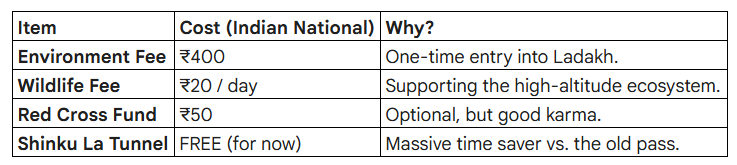
    • The Damage: ₹400 (one-time) + ₹20/day (wildlife fee).

    • Pro Tip: Pay it online at lahdclehpermit.in before you lose signal at Darcha.

Route B: The Leh – Nimmu – Padum (The New NPD Road)

The game-changer for 2026. This route is now fully operational, meaning you can loop back to Leh without going all the way to Kargil.

  • Since you’re staying within Ladakh, your standard EDF receipt from Leh covers this entire stretch.


2. The “Outside Bike” Trap (Read this twice)

This is where 80% of bikers get stuck in a “he-said-she-said” with the unions.

  • The Conflict: The Ladakh Bike Union is protective. If you rent a bike in Manali or Srinagar, you can ride it into Padum and into Leh.

  • The Restriction: You cannot use that Manali-registered bike for “local sightseeing” in restricted areas like Hanle or Umling La.

  • The Altiverse Solution: We coordinate the logistics so you don’t end up having your bike impounded at a checkpoint. If you’re solo, be prepared to swap to a “LA” registered bike in Leh for the internal circuits.


3. Documents: The “Physical” Rule

It’s 2026, and we love digital, but the Indian Army loves paper.

  • The 10-Copy Rule: Carry at least 10 physical photocopies of your EDF receipt and your Aadhaar/Driving License.

  • Why? At checkpoints like South Pullu or Kargyak, the soldiers often keep a physical copy for their logbooks. No signal = No “let me show you the PDF on my phone.”


4. 2026 Cost Breakdown (Permit Only)


The Altiverse “Vibe Check”

Zanskar is changing fast. With the Shinku La tunnel work in full swing, the “raw” feel of the valley is being replaced by tarmac. If you want to see the Phugtal Monastery or the Zangla Palace while they still feel like the edge of the world, 2026 is your year.

“While this guide focuses on the specific ruggedness of the Zanskar Valley, remember that Zanskar is now part of the larger Ladakh circuit. If your 2026 itinerary includes crossing over into Leh, heading toward the high-altitude silence of Hanle, or tackling the world’s highest motorable road at Umling La, you’ll need to navigate a broader set of regulations. For a deep dive into the overall region—including specific rules for internal Leh circuits and rental bike union policies—check out our comprehensive Guide to Ladakh Bike Trip Permits (2026 Edition) to ensure your paperwork is as solid as your ride.”

Ready to stop scrolling and start exploring?

Check out our Zanskar 2026 Expeditions and let us handle the permits while you focus on the hairpins.

Ready to Explore
the Altiverse?

Whether you're dreaming of mountains, beaches, or bustling streets, we'll help you turn travel plans into unforgettable memories.